
COMPOSITE FENCING IN AUSTIN, TX: IS IT WORTH IT?
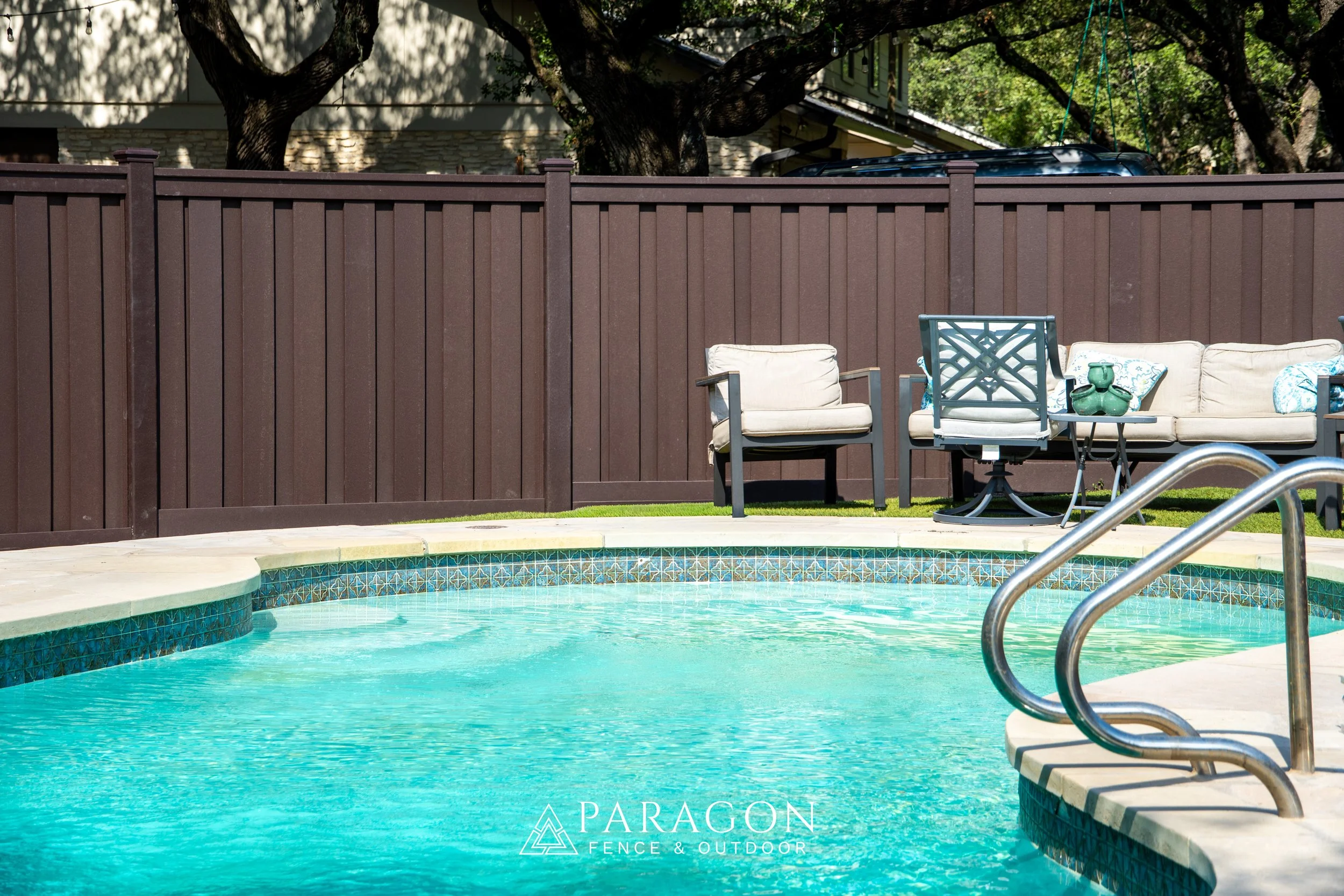
If you’ve been looking at fence options in Austin, you’ve probably come across composite fencing.
It’s usually easy to spot. Composite fences have the privacy of a traditional wood fence, but with a cleaner, more uniform appearance. And unlike cedar, there’s no staining every few years to keep the fence looking the way it did when it was installed.
The catch? Composite fencing costs more upfront.
So the question we usually hear isn’t whether composite looks good. It’s whether the additional cost is actually worth it, especially here in Central Texas.
For some homeowners, absolutely. For others, cedar is still the better choice.
Here’s what we think you should know before choosing a composite fence for your Austin home.
WHAT IS A COMPOSITE FENCE?
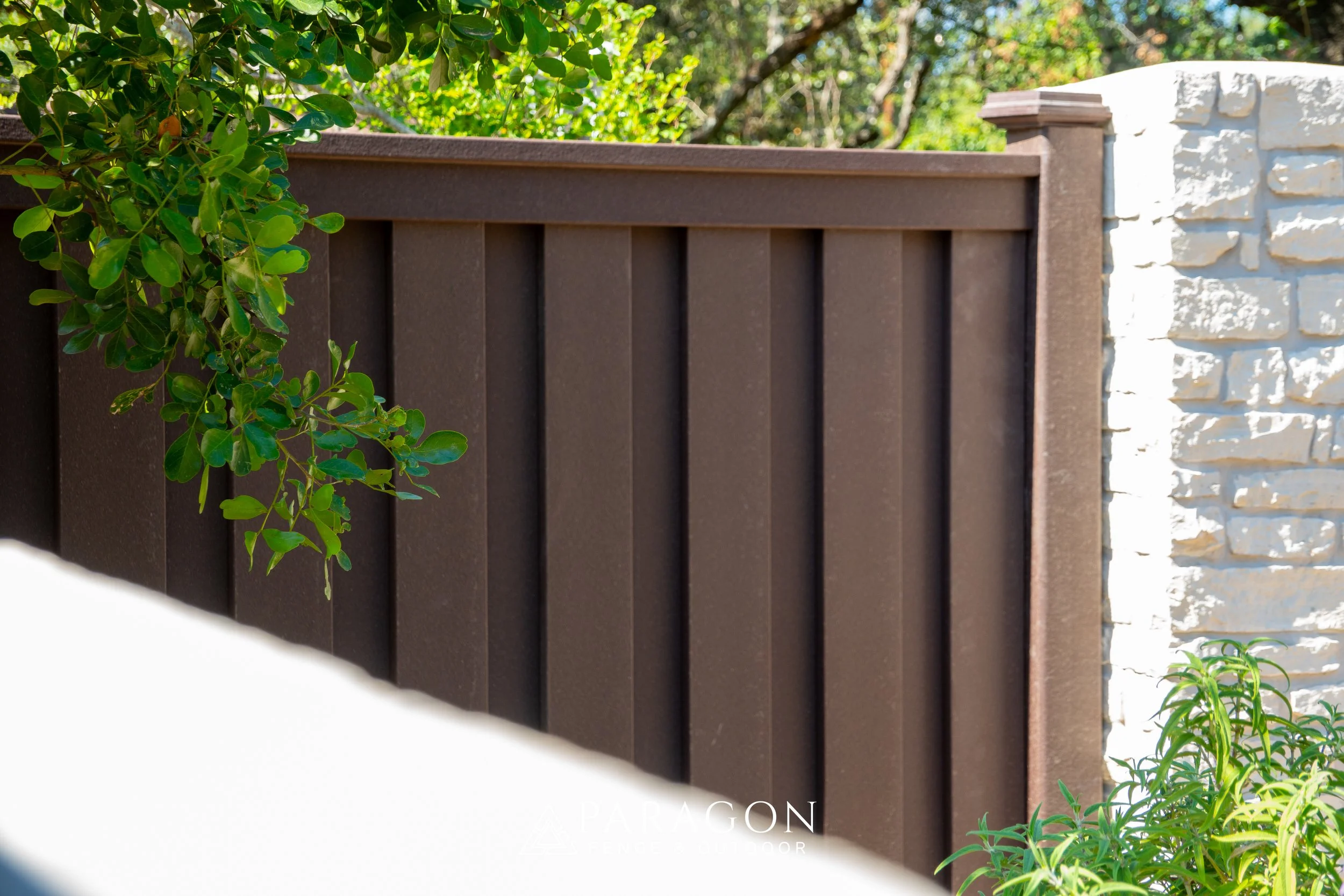
Composite fencing is made from a combination of materials rather than traditional lumber. Depending on the manufacturer, that typically includes recycled wood fibers and plastic.
One of the most recognizable options is Trex fencing, although Trex isn’t the only composite fence manufacturer on the market.
The idea is pretty simple: create a fence that gives you the substantial look and privacy people like about wood without many of the maintenance issues that come along with natural lumber.
Composite fence boards don’t need to be stained or painted. They also aren't susceptible to rot in the same way wood is, and you don't have to worry about individual pickets warping, splitting, or shrinking as they age.
That can be especially appealing in Austin.
WHY COMPOSITE FENCING MAKES SENSE IN AUSTIN
Central Texas isn't particularly easy on fences.
We have long stretches of intense sun, periods of drought followed by heavy rain, occasional freezes, severe storms, and soil that can move quite a bit as moisture levels change.
Wood is a natural material, so it responds to those conditions.
A well-built Western Red Cedar fence can hold up extremely well here, and cedar is still one of our favorite fencing materials. But even a good cedar fence requires some maintenance if you want to preserve its original appearance.
Composite is different.
There’s no stain schedule to keep up with and no natural wood color to preserve. For homeowners who want a privacy fence that looks finished without adding another maintenance project to the list, that's a pretty big advantage.
COMPOSITE FENCE VS. WOOD FENCE
This is where we think the conversation gets more interesting, because there isn't really a universal winner.
If you love the variation, grain, and warmth of real wood, composite isn't going to perfectly duplicate it.
Western Red Cedar has a character that manufactured materials simply don't have. It can also be customized into an enormous range of fence styles, and the upfront cost is typically lower than a premium composite fence.
Composite wins in a different category: consistency and maintenance.
The color is more uniform. The boards don't need to be stained. You aren't dealing with the same shrinking, cracking, or individual picket replacement that can happen as a wood fence ages.
That makes composite particularly attractive for homeowners who expect to stay in their home for a long time or simply don't want to maintain a wood fence.
There’s also the design side of it.
Around a pool, modern home, or highly finished backyard, a composite privacy fence can almost function like an architectural wall. Instead of drawing attention to individual boards, knots, and color variation, you get a much more consistent backdrop.
That can completely change how a yard feels.
WHAT DOES A TREX FENCE LOOK LIKE?
If you've heard someone refer to a “Trex fence,” they're generally talking about a composite fencing system manufactured by Trex.
And no, it doesn't have to look like a deck standing on its side.
One of the things we like about composite fencing is that it can create a very substantial privacy fence with clean lines and finished details.
Depending on the system and design, composite fencing can work particularly well with board-on-board-inspired privacy layouts, cap-and-trim details, masonry columns, custom gates, steel elements, and other architectural features.
That makes it a good option when the fence is going to be a major visual element of the property rather than something you want disappearing into the background.
For example, if you're replacing a fence around a pool, the fence may be visible from almost every seating area in the backyard. In that situation, material and design can have a surprisingly large impact on the finished space.
DOES COMPOSITE FENCING REQUIRE MAINTENANCE?
Low maintenance doesn't mean no maintenance.
Composite fencing can still collect dirt, pollen, dust, mildew, and whatever else Central Texas decides to throw at it.
But the maintenance is generally much simpler than maintaining the finish on a wood fence.
You won't need to periodically stain the boards to maintain their color. Most routine maintenance comes down to cleaning the fence when it needs it and inspecting the structure and gates periodically.
And gates are worth mentioning here.
The fence infill may be composite, but a gate still has moving parts and structural requirements. The way the gate is framed, supported, hinged, and installed matters just as much as the material you see from the outside.
A beautiful low-maintenance fence doesn't help much if the gate starts dragging six months later.
WHAT ABOUT AUSTIN'S SOIL?
This is something homeowners sometimes overlook when comparing fence materials.
You can buy an expensive fence product and still end up with a bad fence if the structure underneath it isn't built correctly.
Austin-area soil conditions vary considerably. Some properties have expansive clay. Others get into limestone and rock quickly.
That's why we don't think post installation should be treated as an afterthought.
The appropriate post depth, footing, post material, drainage conditions, grade, and weight of the fence all need to be considered as part of the system.
Composite fencing can reduce maintenance above ground, but it doesn't eliminate the fundamentals of good fence construction.
The posts still matter.
A lot.
CAN YOU COMBINE COMPOSITE FENCING WITH STONE OR MASONRY?
Yes—and this is one of our favorite ways to use it.
If a property already has stone or masonry columns, we can often incorporate those into the new fence design. Existing columns may be repairable, and additional columns can sometimes be built to match so the fence looks like it was designed as one complete system.
Composite also pairs well with masonry because both materials have a more substantial, architectural feel.
Instead of simply replacing the old fence panels between existing columns, we can look at the entire fence line: column spacing, gates, transitions, cap details, fence height and how all of those pieces relate to the house and landscape.
Those details are what make a finished fence feel intentional.
HOW LONG DOES A COMPOSITE FENCE LAST?
One of the primary reasons homeowners consider composite fencing is longevity.
Unlike natural wood, composite isn't relying on stain to protect its appearance and isn't subject to wood rot in the same way a cedar or pine picket is.
But the lifespan of the finished fence still depends on more than the boards.
Posts, footings, hardware, gate construction and installation quality all matter. A premium fence material installed on a poorly built structure is still a poorly built fence.
When comparing quotes for composite fence installation in Austin, we'd pay just as much attention to how the contractor plans to build it as which brand of composite they're using.
IS COMPOSITE FENCING MORE EXPENSIVE THAN CEDAR?
Generally, yes.
Composite fencing is typically a premium fence option, and the initial material cost is higher than a standard wood privacy fence.
But upfront price isn't the only number worth considering.
With wood, there can be future costs associated with staining, cleaning, repairing damaged pickets, and eventually replacing sections as the material ages.
Composite shifts more of that expense to the beginning.
That doesn't automatically make composite the better financial choice. It depends on the size of the project, the particular product, how long you plan to own the home, and how much you value reducing maintenance.
We'd rather walk a homeowner through those tradeoffs than automatically recommend the most expensive option.
IS A COMPOSITE FENCE RIGHT FOR YOUR HOME?
Composite fencing is worth considering if your priorities are:
Maximum privacy
Low maintenance
Consistent color and appearance
A clean, finished look
Long-term durability
Less concern about staining, warping, or replacing individual wood pickets
On the other hand, if you love the natural appearance of wood, want maximum design flexibility, or need to keep the initial project cost lower, a properly built cedar fence may make more sense.
There are also plenty of projects where we can combine materials.
That's one of the advantages of approaching the fence as part of the outdoor design instead of treating it as a standalone product.
LOOKING FOR COMPOSITE FENCE INSTALLATION IN AUSTIN?
At Paragon Fence & Outdoor, we design and install composite fences, cedar fences, custom gates, masonry features, and other outdoor structures throughout the greater Austin area.
We serve homeowners across Austin, Cedar Park, Leander, Round Rock, Georgetown, West Lake Hills, Lakeway, Jonestown, Lago Vista, Steiner Ranch, Tarrytown, Mueller, and surrounding Central Texas communities.
If you're considering a Trex fence or another composite privacy fence, we'll walk through the property with you, talk about what you're trying to accomplish, and compare the options that make sense for your yard.
Sometimes that's composite.
Sometimes it's cedar.
And sometimes the best solution is a combination of materials.
The goal isn't to sell you the most expensive fence. It's to build you the right one.
Planning a composite fence in Austin? Reach out to Paragon Fence & Outdoor to schedule a site visit and get a quote.