
THE TRUTH ABOUT FENCE PRICES
because not every fence company is charging for the same thing.
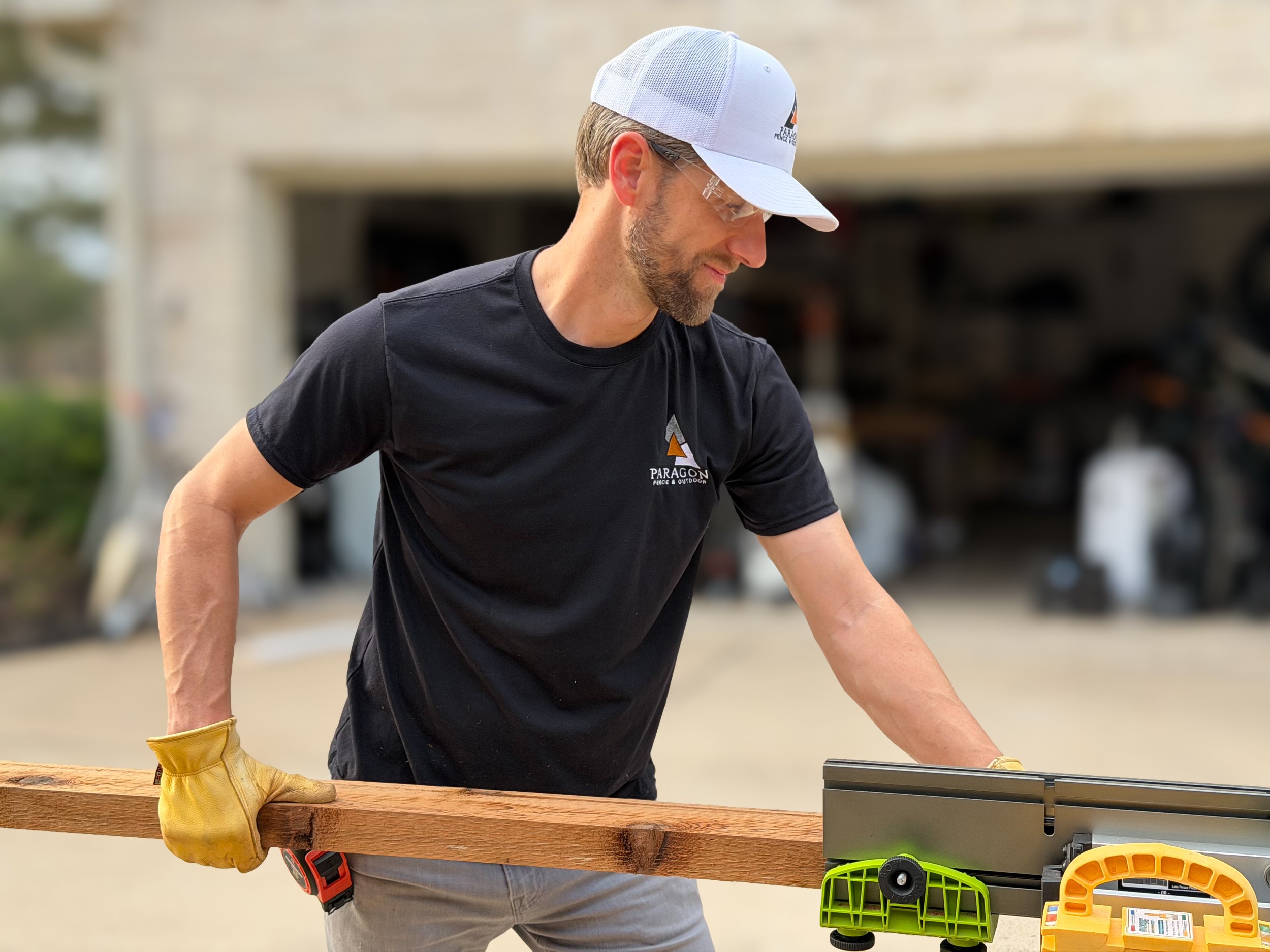
Paragon’s owner, Jefferson, building a garden trellis.
If you’ve ever requested multiple quotes for a fence in Austin, you’ve probably noticed the prices can vary quite a bit.
That’s not unusual. In fact, it’s one of the most common things we hear from homeowners when they’re planning a fence project.
Often they’ve received quotes for way more or way less, and it makes it hard for them to understand who to choose.
Fence pricing in the Austin area usually comes down to three things: materials, labor, and how the business operates. And not every company approaches those the same way.
MATERIAL COSTS CAN VARY A LOT
Most fences use some combination of wood, steel, fasteners, and hardware. But within those categories, the quality and cost of materials can vary significantly.
Pricing depends on factors like durability, supply and demand, availability in Central Texas, and where a contractor sources their materials.
Here are a few things people in Austin ask for which have remarkably different costs, depending on what the contractor plans to use:
CEDAR PICKETS
Japanese cedar (also called “Sugi,” “Island Cedar”, or “Import Cedar”) is relatively new to our area and costs much less than western red cedar. Western red cedar is better at resisting rot, cracking, warping, and insect damage. While it costs more upfront, it also holds its appearance longer, which is why many higher-end fences in Austin neighborhoods use cedar, or are even required to by their HOA.
Both materials can work well depending on someone’s priorities, but they’re not interchangeable—and they don’t cost the same.
Besides the species of lumber, pickets range in thickness from 1/2” to 1”, which also affects cost.
STEEL POSTS
Some companies use thin steel posts, which look the same on the outside, but are more likely to buckle under heavy wind. We use heavy-duty steel posts and we often purchase longer lengths of steel so we can set our posts deeper than 24” depending on the type of soil we’re building in.
IRON FENCING
Manufacturer warranties on iron fencing can vary from 5 to 20 years, which directly corresponds to how durable the finish is. For example, some iron panels are not made with galvanized steel, so they rust quickly. Some are powder-coated but not galvanized, so if any of the powder-coating scrapes off, the metal underneath is still prone to rust. Our standard is to use iron fencing that is both galvanized and black powder-coated and which has 15 to 20 year manufacturer warranties.
STEEL THAT GETS THAT “RUSTED” LOOK
There are two kinds of steel that are typically used in fencing and landscaping which achieve that rust patina—mild steel or corten steel (also called weathering steel). Corten is more costly, much more durable, and requires more specialized equipment.
Corten forms a protective rust patina when exposed to the elements, which actually helps protect the steel underneath. Because of that, it’s commonly used in landscaping, bridges, and other architectural projects where longevity matters. Corten can easily last decades.
Mild steel behaves differently. It still rusts, but unlike the stable and protective patina on corten, it will continue to corrode over time. When we use mild steel, we like to use thicker options, which helps with longevity.
LABOR IS SKILLED WORK
Labor is another major factor that affects the cost of a fence in Austin.
Fence crews that are experienced and have a quality-centric approach understand how to set posts properly, keep long fence runs straight and level, build gates that don’t sag, and handle uneven terrain. That kind of work comes from years of practice.
Most fence companies subcontract their installation crews, and the best crews are paid higher rates because their work is consistent and reliable.
Texas doesn’t require a state license to install fences, which means technically anyone can start installing fences. But building fences that last in Central Texas conditions—heat, clay soil, shifting ground, slopes and grade changes—requires experience.
We’ve spent more than a decade working with the same crews and refining how we approach installation. That includes training on different building techniques, solving complicated yard layouts, and figuring out what holds up best in local conditions.
Good craftsmanship takes time, and we pay our crews accordingly. We don’t negotiate our rates with customers because we don't negotiate on our quality standards or our people. We know some companies lower their price by taking it out of labor rates or cutting corners. When you see the amount of ethic and hard work our crews do, whether it’s 35 degrees out or 108, we’d like to think you’d agree. On the other side of those builds are humans we’ve spent time investing in and building relationships with.
More experience and craftsmanship may mean a higher price—but it also tends to mean a better-built fence.
OPERATING COSTS AFFECT PRICES
Another thing that influences fence pricing in Austin is how a company runs its business.
Many homeowners contact the companies they see at the top of Google search results. Those sponsored spots cost money. A lot of money, in some cases.
Beyond advertising, businesses also pay for things like bookkeeping, employee wages, insurance, tools, fuel, and taxes. Running a legitimate fence company in Austin comes with real overhead, and those costs vary widely depending on how the company operates.
Some companies invest heavily in marketing and lead generation. Others rely more on referrals, word of mouth, and long-term reputation. Neither approach is wrong, but it does affect pricing.
BUDGET IS PERSONAL
When people ask about the cost of a fence in Austin, the word “expensive” comes up a lot.
But expensive is relative.
Think of it the same way you might think about hiring a photographer, tattoo artist, or hairstylist—everyone has a different budget and a different level of experience they’re comfortable paying for.
A $6,000 fence that’s falling apart after 5 years is expensive, especially when it needs to be re-built early. Which means you’ll be back in the fence market sooner than you need to be. A $10,000 fence that looks good for 30 years is an investment.
Some fence companies know this, and focus on speed and quantity over quality and longevity.
That said, we all have different budgets and goals. For some homeowners, the priority is getting the lowest price possible. For others, the focus is durability, materials, and craftsmanship. Both perspectives are valid. It simply depends on what someone is comfortable spending, or what they can afford, and what they expect from the finished project.
OUR APPROACH
After nearly two decades in the fence industry, we’ve developed strong standards for how we build while also trying to keep our operating costs reasonable.
For example, we don’t pour large budgets into Google ads, mass mailers, or aggressive marketing campaigns. Those strategies work for many companies, but they’re not where we prefer to invest.
Instead, we focus on building quality fences and letting our work speak for itself.
When we quote a fence project, we typically start with our standard build. That includes materials like western red cedar pickets, stainless steel nails, and durable exterior screws designed to hold up in Austin’s climate.
From there, we can adjust materials, design features, or upgrades depending on what the homeowner wants and what fits their budget. That said, no matter who you are, or what your budget is, we always build with quality and longevity in mind. And we con’t corners just because you went with a different material option.
So, while our goal isn’t to be the cheapest fence company in Austin, it is our goal to build fences and other outdoor features that hold up well and that we’re proud to stand behind years later.